
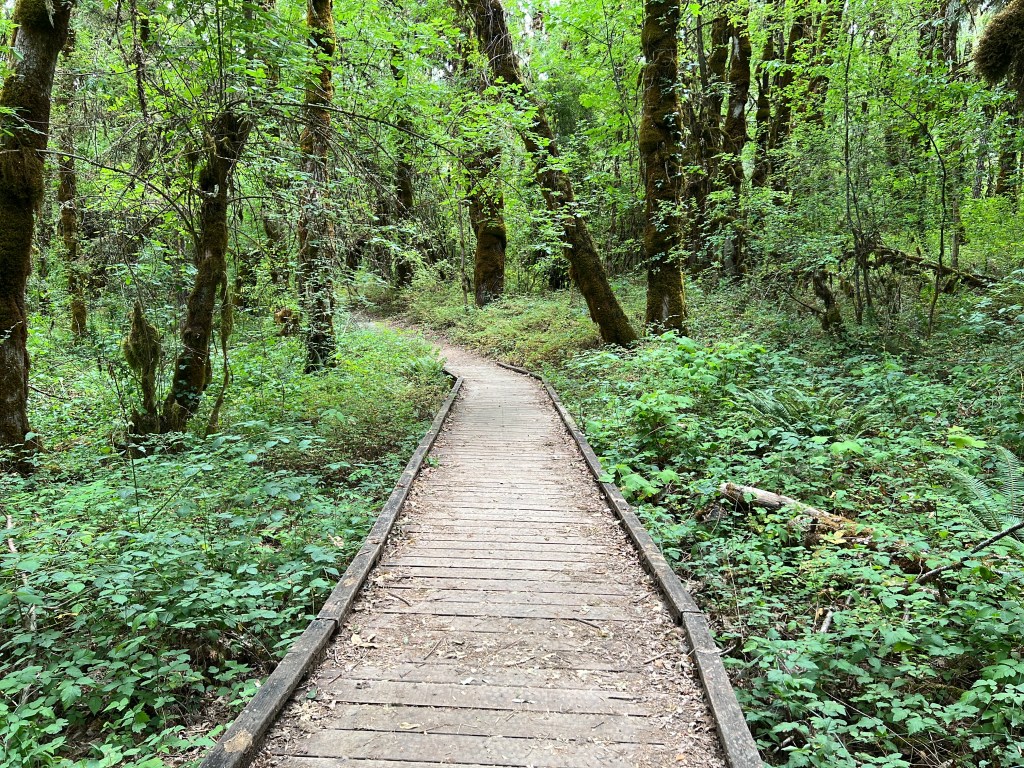
The William L. Finley National Wildlife Refuge is about 30 miles north of Eugene, on Highway 99W. The refuge was established in 1964, and as described on the Refuge’s website, visiting is “like taking a step back into the natural history of the Willamette Valley.”
Hideko and I visited the Finley Refuge on July 24 and hiked the Mill Hill Loop Trail in the western corner, as shown on the map provided on the U.S. National Fish & Wildlife Service website.
In preparing this article, I looked through the Atlas of Oregon to understand more about the landscape of the Refuge and the Mill Hill Loop Trail. The Atlas uses the four-level ecoregion framework pioneered by the late geographer James Omernik at the Environmental Protection Agency (EPA) research laboratory in Corvallis.1
The Atlas describes the vegetation type of the land the trail passes through as Oregon White Oak/Douglas-Fir. The terrain fits the ecoregion description of valley foothills (one of the four ecoregion sub-types in the Willamette Valley).2
We have hiked this moderate-difficulty trail several times and especially enjoy the quiet background that highlights a variety of birdsong, including Acorn Woodpeckers (Melanerpes formicivorus) and Purple Martins (Progne subis) that we heard there. On this Monday hike, we met no other people on the trail—one of the simple pleasures of being retired.
I posted a short video of this hike on YouTube, showing the mixed forest landscape.
The background to the effort to establish the Finley Refuge is described in fascinating detail by David B. Marshall in his Memoirs of a Wildlife Biologist .
In early 1960, near the end of my Malheur Refuge assignment, a general memo from the Washington office was transmitted to the field requestiong inpur on waterfowl habitat that had the potential to be added to the National Wildlife Refuge System. I recognized there were no National Wildlife Refuges in the Willamette Valley, an important waterfowl wintering area, especiallyfor the dusky Canada goose. This afforded me the opportunity to fulfill my “dream” that a refuge (now the William L. Finley National Wildlife Refuge) could be established in the Muddy Creek area south of Corvallis where I had spent so much time while a student at Oregon State College.
Memoirs of a Wildlife Biologist, David B. Marshall, p. 118 (out of print).
- You can read more about the ecoregion framework in the report “Ecological Regions of North America: Toward a Common Perspective” by the Commission for Environmental Cooperation (CEC). ↩︎
- The other three Willamette Valley ecoregion sub-types are Portland/Vancouver Basin, Willamette River Gallery Forest, and Prairie Terraces. Atlas of Oregon, p. 173. ↩︎
 Walking with Curiosity
2 responses to “Mill Hill Loop Trail”
Beautiful video with perfect music. Excellent article!
Sent from my iPhone
<
div dir=”ltr”>
<
blockquote type=”cite”>
LikeLike
Thank you very much for the kind feedback Judith! I am delighted to know you enjoyed it.
Tom
LikeLike