
Introduction
We now have the answers to some important questions about the 2024 season of the Ospreys nesting here along the Willamette River in Eugene, Oregon: When will we see the first hatchling, how many hatchlings will there be, and when will they take their first flights?
In my last blog post about this Osprey season, published on June 10, I noted that I have been following this nest, which I call the Boulders nest, since 2020, and that it has been continuously occupied for many years.
I also wrote about how deep the Boulders nest is now, such that the hatchlings are not visible until a few weeks after they emerge from the eggs. If there was a nest cam, we wouldn’t have to speculate. 1
On June 20, the head of one hatchling was just visible over the top of the nest, under its mother.2 The Ospreys at this nest last year had a later nesting start, and I only saw the first hatchling on June 29; here is the link to that article.
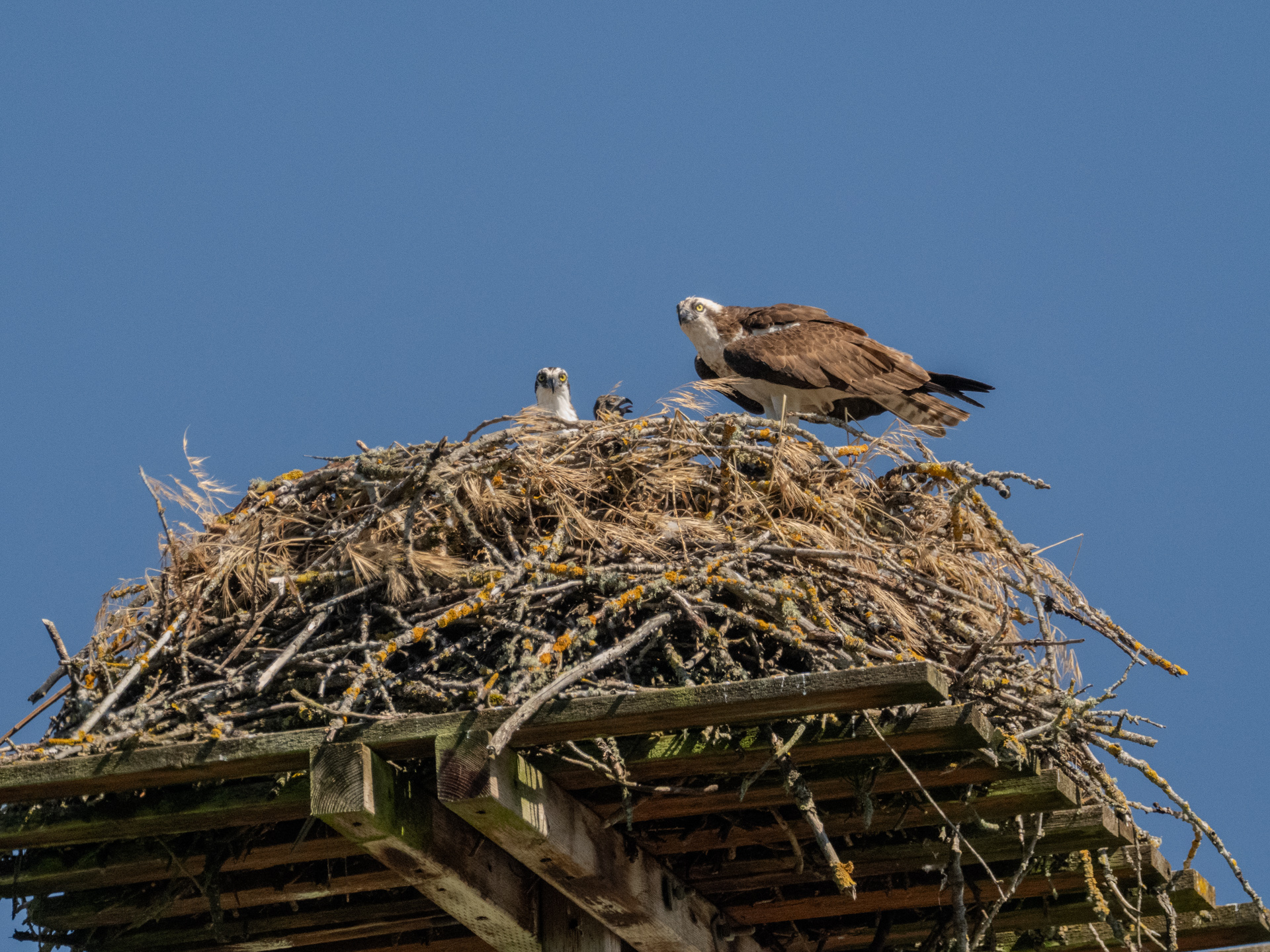
The next day, I enjoyed seeing both parents with a hatchling.
From my observations in prior years, I knew that all the hatchlings don’t become visible for some time, so now, having answered the when question, the answer to the how many question remained.
Two Hatchlings
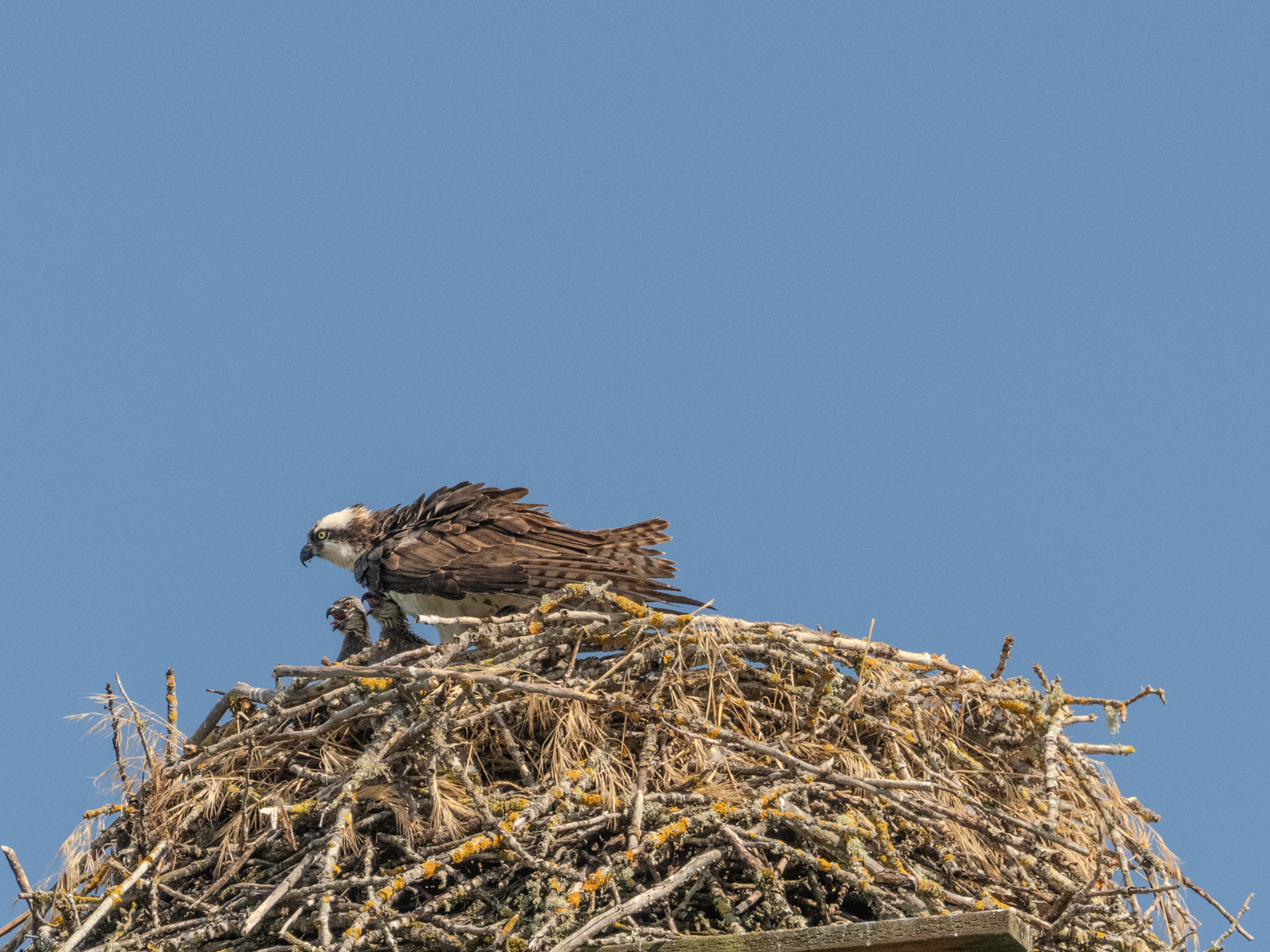
Until June 30, I had seen one hatchling in the Boulders nest, but on that day, I could clearly see a second little head under the adult female. Last year, I saw the second hatchling on July 10; here is the link to that article.
The Ospreys in the Boulders nest usually have three hatchlings, and, as Osprey expert Alan F. Poole puts it, “most Ospreys lay three eggs.” 3 In 2022, the Boulders Ospreys only fledged one juvenile.
Having seen two hatchlings, I hoped there was one more.
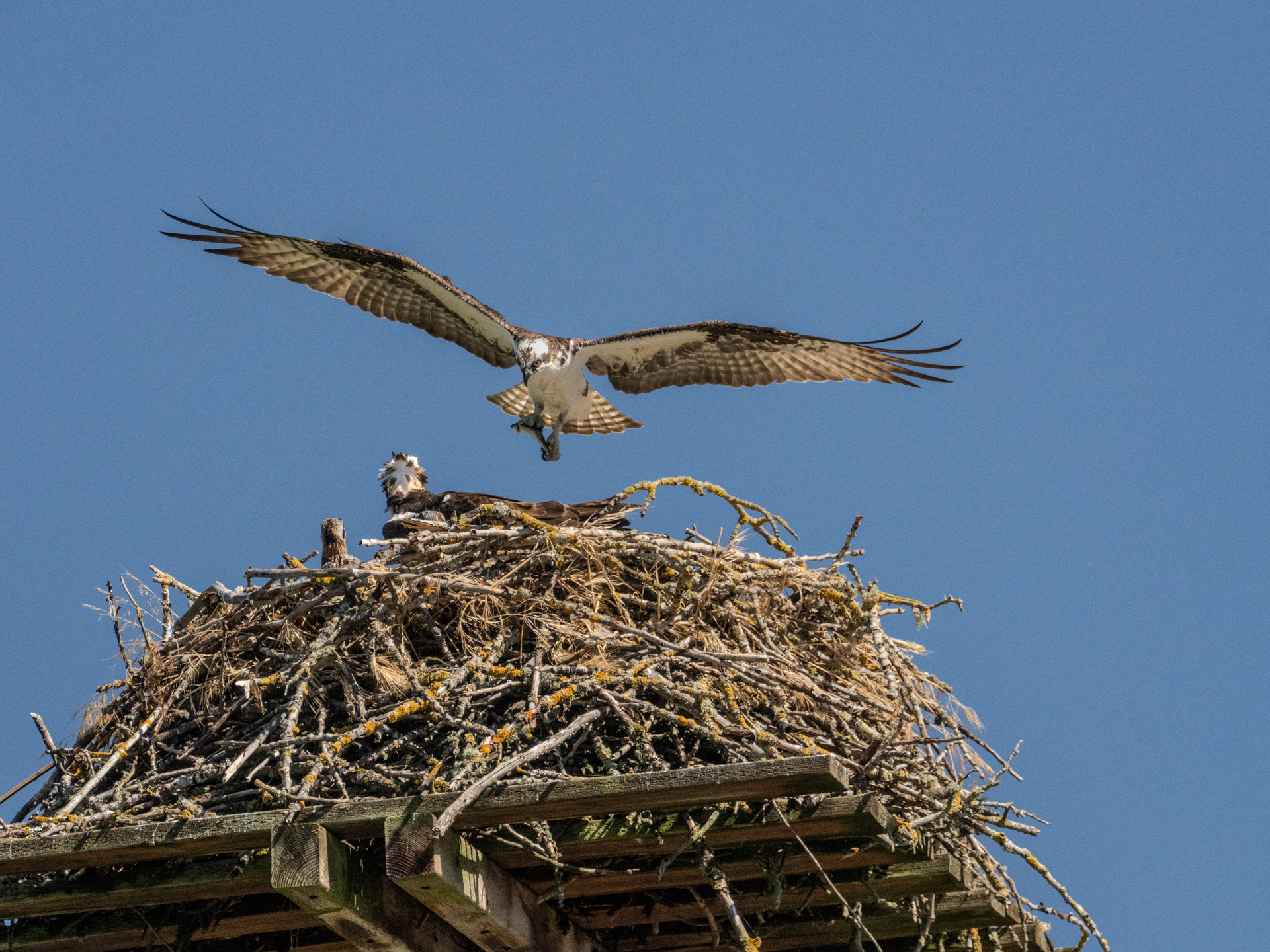
With hatchlings in the nest, the adult male has to be purposeful in bringing fish to the nest, as in the photo above from July 2.
Three Hatchlings
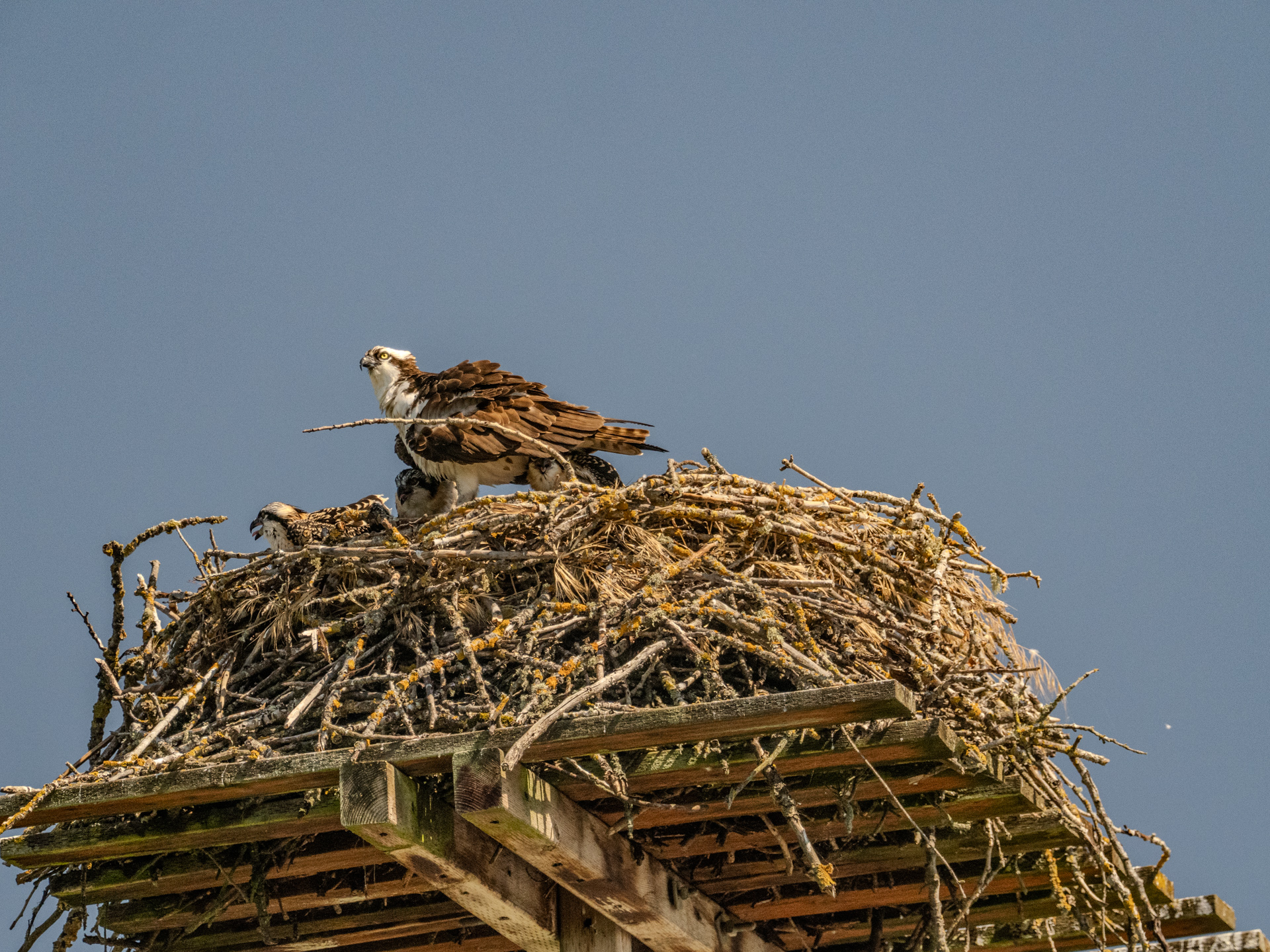
On the thirteenth of July, I could see the adult female with three juveniles under her, sheltering from the hot sun.
Young pant on hot summer days; small young are especially vulnerable; female shades young until they become too large for this to be possible. 4
Feeding
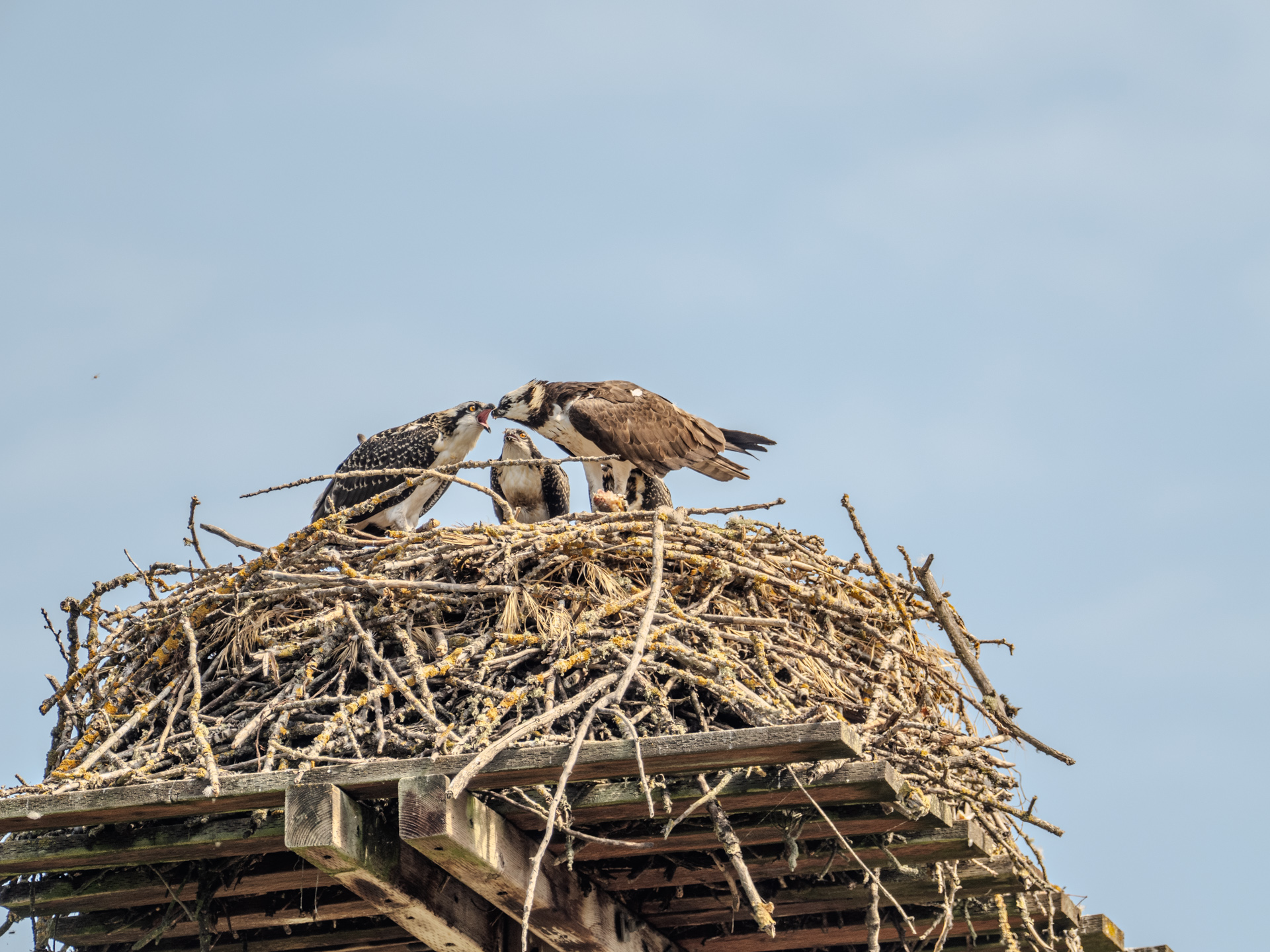
The adult female continues to feed the juveniles, even though they have also begun to tear into the fish by themselves.
Osprey are almost exclusively fish eaters, and they apparently favor largescale sucker fish in the Willamette River, but I haven’t seen the adults with one of these big fish yet this year.
Growing Up
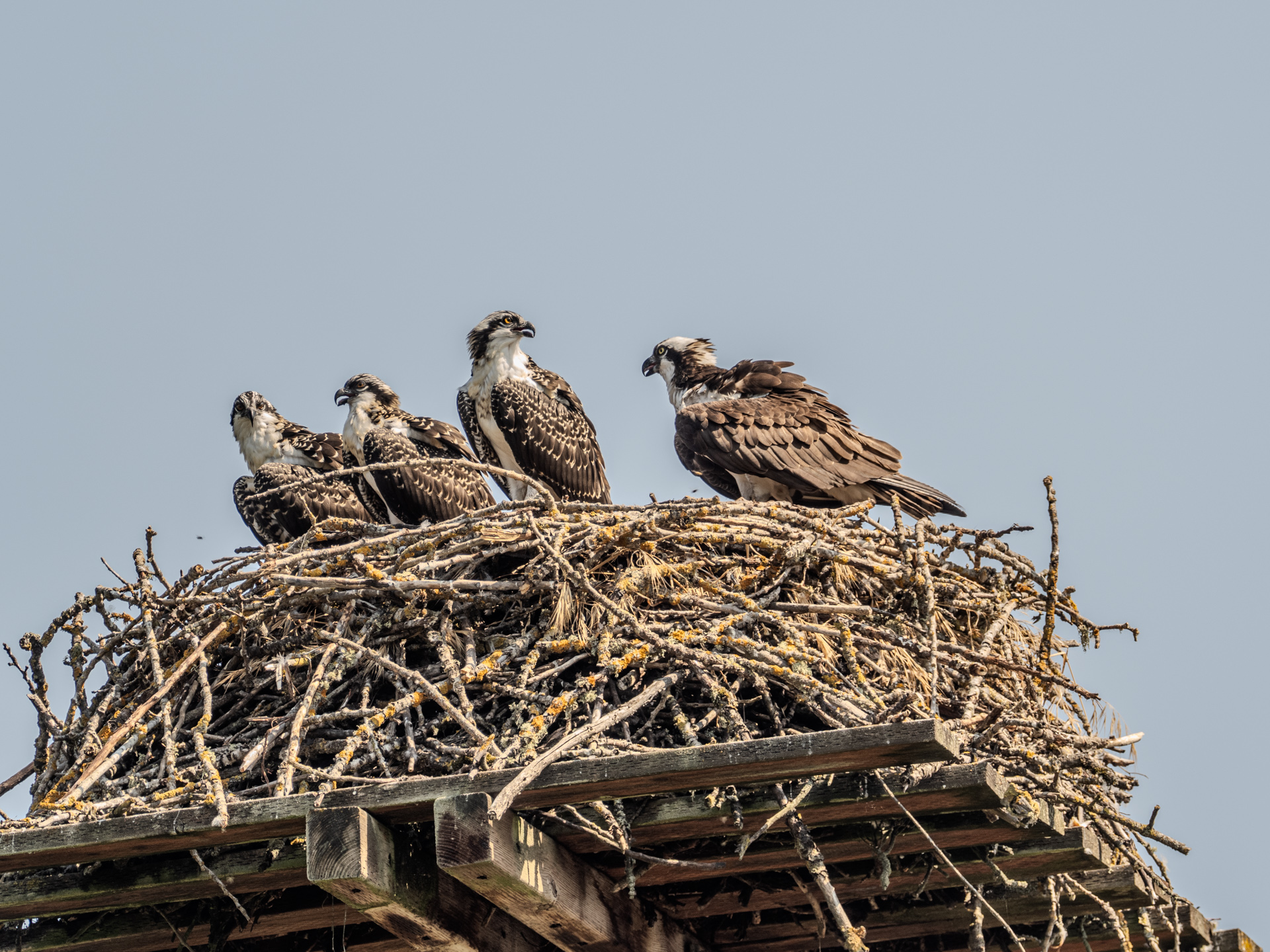
In 2023, one of the three Boulders juveniles was much smaller than the others, and I was worried it might not survive. Fortunately, the runt in 2023 fledged, albeit later than his sisters; here is the link to that blog post.
This year, all three juveniles appeared to be about the same size, and by the second of August, they all appeared ready to take their first flight.
Fledging
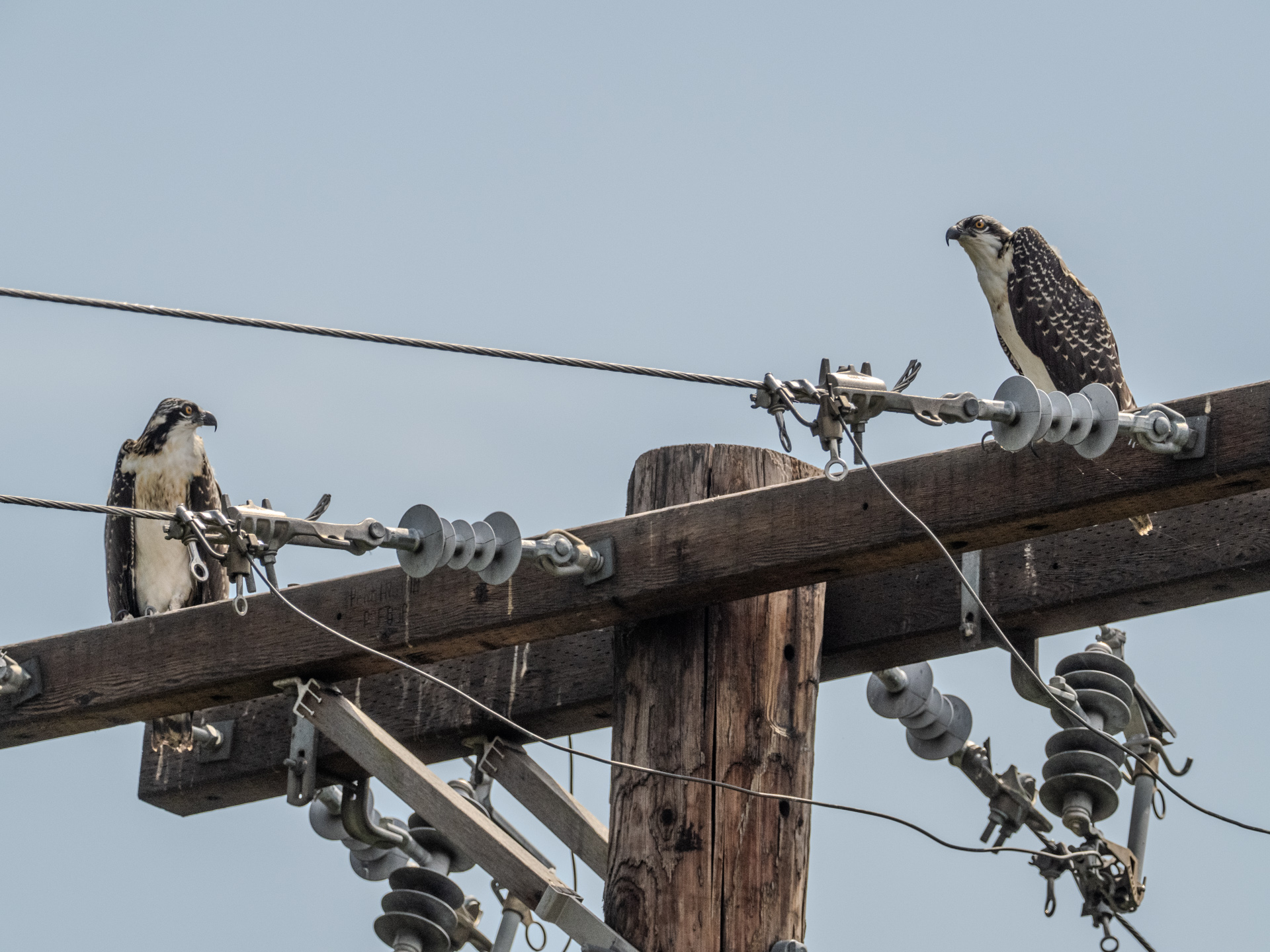
On the third of August, I saw only one juvenile in the nest and couldn’t see the others. Then, I noticed a passerby looking up at the top of a utility pole that was obscured from my view and realized where they were. The other two juveniles had taken one of their first short flights there, as I had observed in previous years until they had gained confidence in their flight and landing ability.
A few minutes later, it appeared that the juvenile at the nest had also taken flight. In 2023, the first day I observed the juveniles flying was August 19.
The juveniles usually return to the nest when fish is delivered, but I have also seen adults bringing fish to the juveniles on these utility pole perches.
After first flight, fledgling generally remains at the nest or nearby; parents bring fish back to young, which can rip it apart to feed themselves, but some persist in being fed by adults well into the fledgling period. 5
Taking a Break
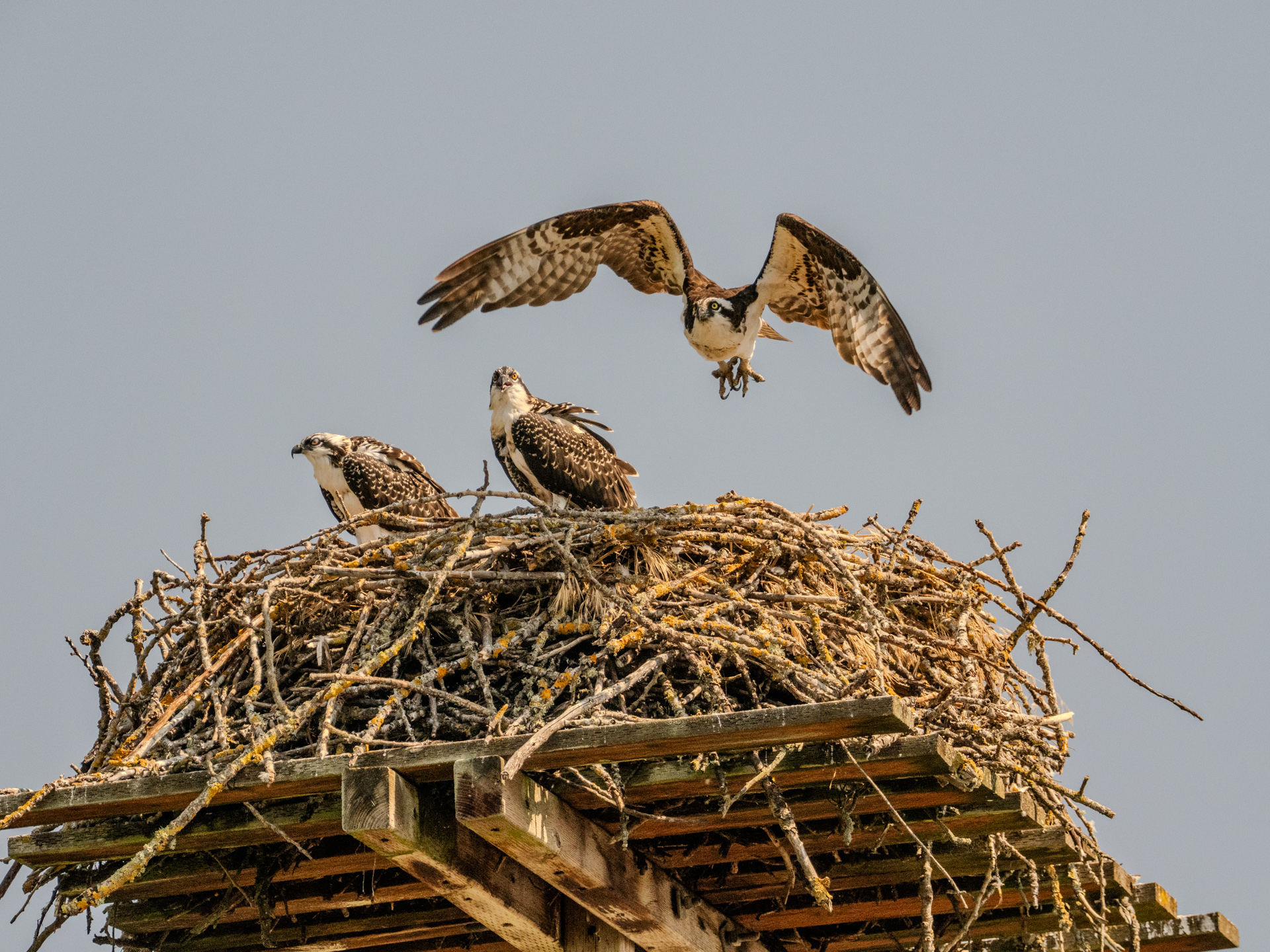
As the juveniles grow, and especially once they have fledged, the adult female begins to spend more time away from the nest. On August 4, I watched as the Boulders adult female took off to fly around for a few minutes.
In migratory populations female parents generally head off on their own soon after their young fledge, often finding nearby feeding grounds where they begin to regain the weight they have lost during the nestling period. But the male stays on, and his role is critical in bringing fledgling Ospreys to independence. 6
Owosso Nest
The Owosso nest, about 1 mile downstream from the Boulders nest, appears to have only fledged one hatchling this season, the same as in 2023. At one point, we saw two little heads in the nest, but now there is only one, and it appears to have fledged as well.
We noted that the adult female seemed to frequently spend time away from the nest, so a predator may have gotten the other hatchling, but that is only speculation, as there also is no nest cam at that site.
Osprey Time
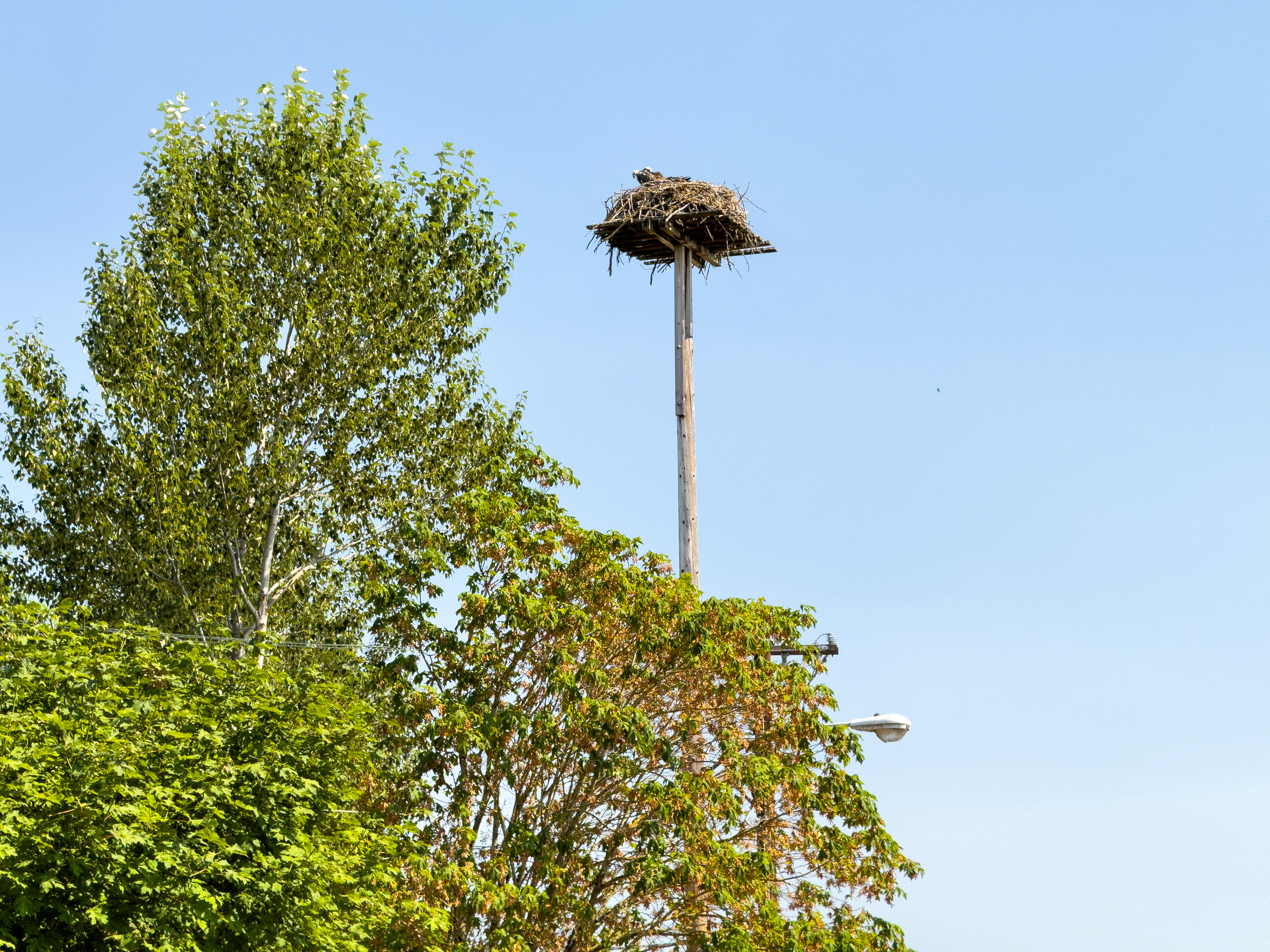
On most days when I visit the nest, it is for thirty to forty-five minutes, and much of that time, there is not a lot of action, but I find being out there quietly observing and occasionally taking photos or videos to be very relaxing. It would be even more so if the nest platform wasn’t next to a busy road, of course.
I often turn to the writing of Osprey expert Alan F. Poole to learn about aspects of Osprey’s behavior. Nature writer David Gessner describes the level of obsession that Poole devoted to gaining his extraordinary degree of knowledge.
…beginning in 1974, that he had done his important early work, charting the recovery rate of the ospreys that began to breed again once DDT was banned. In those days his life was reduced to osprey terms: he spent all his time watching, studying, tagging, and tracking. He was learning things that no one had ever known about ospreys, and he was living in their midst, logging countless hours out in the spartina grass….Ospreys became his way of thinking about the world. 7
The Rest of the Season
The 2024 Osprey season has produced three offspring in the Boulders nest and one in the Owosso nest. Now, they have to learn how to fish before beginning the migration south to their wintering grounds in Mexico.
For the remainder of August, I expect to see the three juvenile Ospreys from the Boulders nest range farther, and I hope to have the chance to photograph them as they perch along the river learning how to fish.
As mentioned above, getting the juveniles ready to migrate is the duty of the adult male, and in 2021 I witnessed a remarkable interaction that suggests there is some transfer of knowledge between parent and child about how to handle fish once they have been caught, even though the general view is that the adults don’t teach the youngsters how to catch a fish. Here is the link to that 2021 post.
- See the nest cam operated by the Montana Osprey Project and the Cornell Lab of Ornithology https://www.allaboutbirds.org/cams/hellgate-ospreys/ ↩
- I haven’t observed at the nest every day this season, so I have probably missed some noteworthy events. ↩
- Ospreys: The Revival of a Global Raptor, Alan F. Poole, p. 92. ↩
- Birds of the World, Cornell Lab of Ornithology, birdsoftheworld.com (paywall) ↩
- Birds of the World, Cornell Lab of Ornithology, birdsoftheworld.com (paywall) ↩
- Ospreys: The Revival of a Global Raptor, Alan F. Poole, p. 104. ↩
- Soaring with Fidel: An Osprey Odyssey from Cape Cod to Cuba and Beyond, David Gessner, Kindle version location 472. ↩
 Walking with Curiosity
4 responses to “2024 Osprey Season: Fledged”
Dear Tom, I was so happy to read your post! I have been wondering! Thank you so very much for tracking ‘our’ osprey. It is always so fascinating and they are so important to me. There is a nest close to where I live, but I haven’t been tracking it. The other day Mia and I were on a walk and I heard babies calling. It appears there are two. I immediately thought of you and our Boulders nest and wondered what was going on there. Then I received your article! I hope you and Hideko are well. I really miss you all and hope to visit sometime in the near future. With Much Appreciation, Love Judith
>
LikeLike
Hello Judith—it is great to know you enjoy reading these updates on the Boulders Ospreys! Thank you for the thoughtful comments and the description of the Ospreys you and Mia spotted.
Tom
LikeLike
Tom, as always, I, so, enjoy reading about ‘our’ Ospreys’. It’s a very unique experience, especially because they return to ‘our’ Osprey Nest each year.
Thanks again,
Jan Rusk
LikeLiked by 1 person
Thank you, Jan! I always appreciate your comments and am delighted to know you enjoy these Opsrey updates!
LikeLike